Showing posts with label hypothesis. Show all posts

Thursday, March 24, 2016

Suffering As A Screening Criteria For Palliative Care Referral

The total pain1 and total dyspnea2 models can be expanded into a model of the multidimensional suffering of patients experiencing serious or life-threatening illness3. These models describe symptom burden in terms of associated physical symptoms and loss of functioning; psychological impact and its effect on emotion, coping, or adjustment; social impacts on identity, role, and relationships; and spiritual impact on coping, existential distress and meaning.
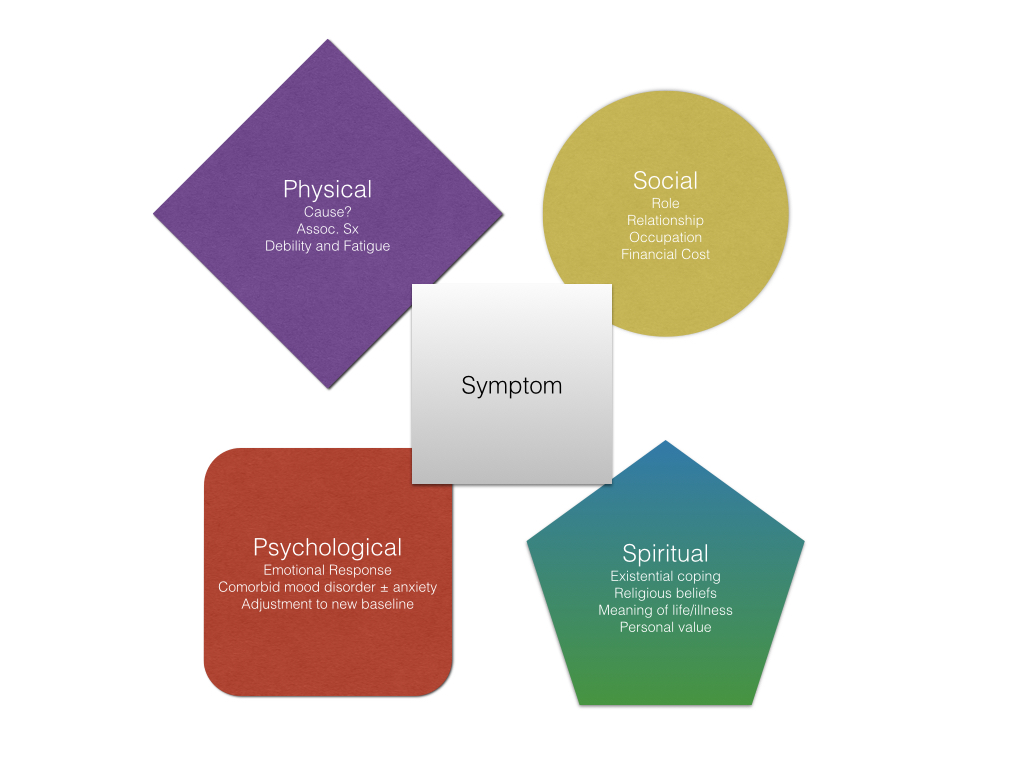
Total symptom model 001

This suffering model has the potential of being a screening criteria for referral to specialist palliative care based on suffering rather than disease state. A hypothetical paradigm to empower patient self-referral might be:

  • Does your disease or its symptoms feel intolerable or make you feel debilitated, weak, or fatigued to an unbearable extent?
  • Does your disease or its symptoms cause you to feel sadness, fear, or anger to such an extent that it impairs your functioning?
  • Does your disease or its symptoms cause you to question your personal, professional or familial identity or role?
  • Does your disease or its symptoms cause you to question your beliefs or cause your beliefs to be unsupportive?
If you answered yes to any of the above questions, would you like to see a team that deals exclusively with diagnosing, managing, treating and preventing this kind of distress?

If they answer yes referral to specialist palliative care team should follow. Just a thought.

References

  1. Dame Cicely Saunders
  2. Curr Opin Support Palliat Care. 2008; 2(2):110-3
  3. www.accessdata.fda.gov/scripts/cdrh/cfdocs/cfcfr/CFRSearch.cfm?fr=312.300

Sunday, October 2, 2011

Laws of Thermodiagnostics

A tongue in cheek application of the Laws of Thermodynamics as applied to medicine:


0th: If two diagnostic findings support a third, then they must support each other. No single diagnostic finding has ever made a diagnosis, it is a careful process of combining and comparing data that makes it possible to reach a diagnostic conclusion. Look at what your "facts" are, the diagnosis with the most "facts" supporting it is most likely the right one. Of course, facts in medicine are not as concrete as we would like to make them seem as demonstrated by false positive and negative results.


1st: You cannot win — A physician's diagnostic performance can be of one form (i.e. specific or sensitive) or another, but cannot be both. If you rule out a lot of different etiologies without ever ruling one in you are highly sensitive but not specific, and your patient still doesn't know what is wrong with them. If you always get positive results to your diagnostic inquiries you are highly specific but not very sensitive, and you are probably missing some disease in other patients because of missed testing.


2nd: You cannot break even — A negative diagnostic work-up does not decrease morbidity or mortality, while a positive one always increases both. Just because you didn't find a pathophysiological reason for a presentation doesn't mean that you didn't miss something or that your patient is any safer from future insults. Confirming a diagnosis simply means that you have named the disease and they now have the same increased risks as others with that disease as well as those from related or unrelated future insults.


3rd: You cannot leave the game — Absolutely false results must be worked-up, as there are no absolutes in medicine. Even the most spectacularly sound medical reasoning for explaining a false positive or random incidentaloma means nothing without further testing to corroborate that reasoning. Missed diagnoses kill, maim, and get doctors sued.


Friday, September 16, 2011

Ten Eyes for Looking at Disease

Hypothesis: All disease is caused by some combination of


I Injury (caused by an exogenous agent, this would include hemorrhage)


I Inflammation (caused by the human organisms response to injury)


Y Immune (caused by under, over, or inappropriate response of the human self-defense mechanism)


I° Infection (caused by an exogenous microbial vector)


I Ischemia (caused by lack of blood flow)


i Inadequacy (caused by mechanical failure)


Aye Incompetence (caused by physiological failure, heart failure would presumably fall in both)


I Intoxication (caused by poison)


I Iatrogenic (caused by doctors)


¿ Idiopathic (caused by an unclear reason that is not included in the above, the cop-out)