Showing posts with label education. Show all posts

Wednesday, June 14, 2017

Never too early to consult for chest pain, always too late to consult for total pain

Palliative care is the diagnosis, prevention, and treatment of suffering—the physical, psychological, social, and spiritual components of disease burden that diminish quality of life. Many patients require only primary and not specialist palliative care, just as many patients with cardiovascular disease risk are managed without a cardiologist. A patient presenting with chest pain may still initially be managed by emergency medicine physicians and these days hospitalists, who will use morphine, oxygen, nitrates and possibly aspirin to palliate the symptoms of chest pain while investigating the etiology of the pain. Those patients that are "ruled-in” for coronary artery disease are referred to a cardiologist for definitive management. Those with unstable angina, non-ST elevation, and ST elevation myocardial infarction will usually be seen by an interventional cardiologist and a subset of those will see a cardiothoracic surgeon. Suffering is much the same, everyone deserves good primary palliative care, some will need specialty palliative care, and still others will take advantage of hospice services depending on the severity of their disease, treatment options, and healthcare goals.

Everyone has some level of cardiovascular disease risk, from minimal to extremely high risk. Similarly nearly all people bear some burden of suffering, for many this burden is minimal in duration and volume, but for others the burden of suffering exceeds their ability to lead a life with an acceptable quality of life. For these patients, palliative care becomes a prerequisite of good care. It has been recommended that palliative care be initiated at diagnosis of serious or life-threatening disease. Unlike cardiovascular disease, where we fear late consultation more than earlier, providers are more fearful of getting palliative care involved “too early” and accept that their patients' suffering is par for the course until very late in the course of their disease. Preventing suffering, like preventing any disease, is the only way to cure it with nearly 100% success and is likely more cost effective. 

Palliative care can always be a support

One of the reasons that palliative care is also called supportive care is because palliative care acts as the scaffolding while curative therapy is undertaken and if it should this fail continues to support the patient to a death with comfort, dignity, and peace. Palliative care uses a multidisciplinary approach to strengthen the pillars of chronic suffering while simultaneously supporting patients through acute insults as their disease and treatment of their disease takes a toll on their overall wellbeing.

Without support

Patients present because of symptoms, looking for relief and answers. While we seek to diagnose, everyone deserves symptom relief. While we treat we must acknowledge that our patients will not instantly feel improved and may sometimes have a period of recovery where they feel worse than they did before we started “helping”. These patients also deserve symptom relief. Acknowledging that healthcare is the discoverer of the source of suffering and sometimes the cause of it does not make us less of a provider but simply more human. Patients that feel better, know more, and plan ahead, unsurprisingly do better. Benjamin Franklin said it best, "In this world nothing can be said to be certain, except death and taxes.” He never said we had to suffer from either.

Thursday, March 24, 2016

Suffering As A Screening Criteria For Palliative Care Referral

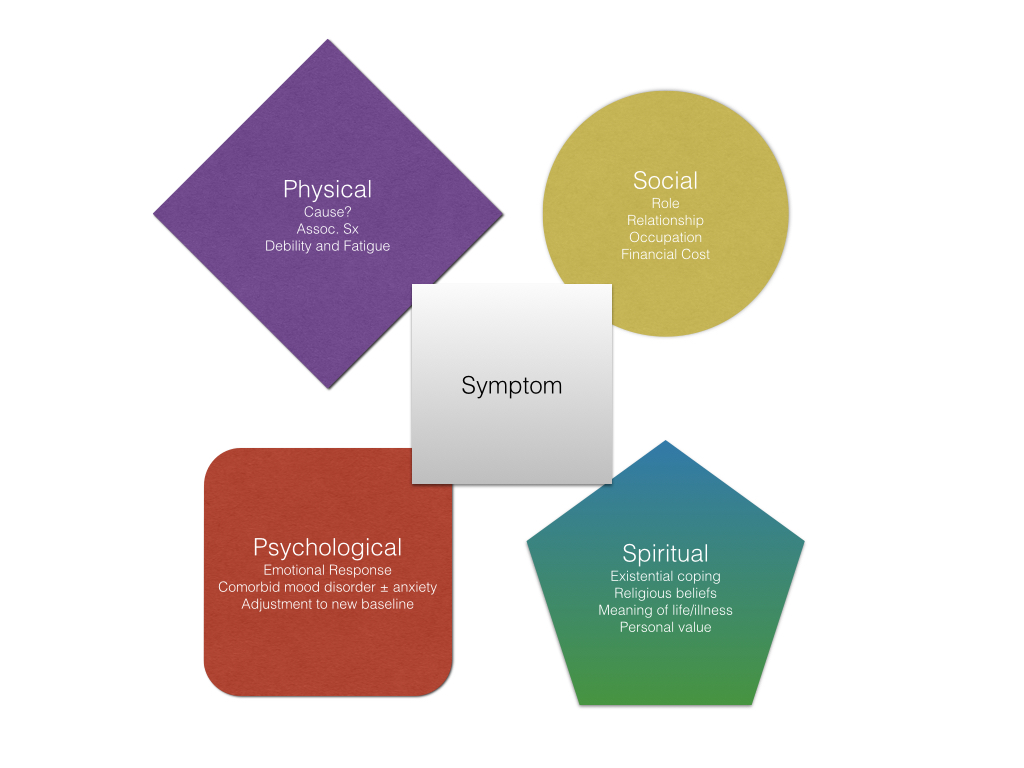
The total pain1 and total dyspnea2 models can be expanded into a model of the multidimensional suffering of patients experiencing serious or life-threatening illness3. These models describe symptom burden in terms of associated physical symptoms and loss of functioning; psychological impact and its effect on emotion, coping, or adjustment; social impacts on identity, role, and relationships; and spiritual impact on coping, existential distress and meaning.

Total symptom model 001

This suffering model has the potential of being a screening criteria for referral to specialist palliative care based on suffering rather than disease state. A hypothetical paradigm to empower patient self-referral might be:

  • Does your disease or its symptoms feel intolerable or make you feel debilitated, weak, or fatigued to an unbearable extent?
  • Does your disease or its symptoms cause you to feel sadness, fear, or anger to such an extent that it impairs your functioning?
  • Does your disease or its symptoms cause you to question your personal, professional or familial identity or role?
  • Does your disease or its symptoms cause you to question your beliefs or cause your beliefs to be unsupportive?
If you answered yes to any of the above questions, would you like to see a team that deals exclusively with diagnosing, managing, treating and preventing this kind of distress?

If they answer yes referral to specialist palliative care team should follow. Just a thought.

References

  1. Dame Cicely Saunders
  2. Curr Opin Support Palliat Care. 2008; 2(2):110-3
  3. www.accessdata.fda.gov/scripts/cdrh/cfdocs/cfcfr/CFRSearch.cfm?fr=312.300

Tuesday, June 26, 2012

Tucking In

In the era of shifts rather than calls, the art of "tucking in" a patient is being neglected.  In the past this generated pages to wake you up but now it generates unneeded business for your colleague who is covering for you.  When the "night float", "nocturnist" or "nocturnalist" is getting paged for a sleeping pill, acetaminophen, or a laxative you are getting a reputation of being lazy, short sighted, and a person who wastes clinical temporal resources.  While your therapeutic regimen may treat the patient, their symptoms do not spontaneously alleviate as soon as the medications hit the blood stream, there is a temporal lag.  In addition, your patient may develop new complaints only peripherally related to their presenting diagnosis.  Imagine, if you will, being a traveller trapped in a hotel room, that you forgot your luggage, and you have to call the front desk for permission to get up to use the lavatory.  This is the powerlessness experienced by patients, who may need trivialities to feel better but have to have a doctor's order to get them.  It is critical to see to the diagnosis and intervene but it is a necessity to see to your patient's comfort as well.  By nature, "tucking in" a patient uses adjunctive measures, medications that the benefits of comfort do not outweigh the risks of side effects, adverse reactions, or worsening the hemodynamic status of the patient.


Rate Controlled Unidirectional Gastrointestinal Motility
People don't like vomiting, nurses like it less than anyone else.  People also like a semblance of bowel regularity and consistency, too much and too little are both subject to complaint, a complaint that is geometrically proportional with age. Symptomatically treating nausea, vomiting, diarrhea, and/or constipation does not solve the problem, your diagnostic inquiry and therapeutic intervention must still proceed.  Where I trained ondansetron was the front line antiemetic of choice, however it can only be given twice in one day.  Therefore a breakthrough or back-up agent such as prochlorperazine, promethazine or metoclopramide is a good idea.  If their nausea and emesis is due to a systemic response to ischemia or infection, the management of the the cause will fix their symptoms, the time delay in improving cardiac perfusion and treating that urinary tract infection will be covered by anti-emetics.  If the nausea and vomiting are due to obstruction or ileus you will be better served with a nasogastric tube to low intermittent suction than just anti-emetics, alleviating the distention and pain which may or may not help the actual problem does help their symptoms, without hiding that massive amount of intestinal content that is just waiting to be ejected when their vomiting centers come back on-line.  Lastly, look the side effects of analgesia, opioids are notorious for causing nausea and vomiting, sometimes simply switching your analgesic regimen will help.
On the back end, people like a "normal" bowel routine.  Once the rate, composition, and volume changes they get concerned and want action.  Constipation must be excluded from ileus or obstruction.  In constipation you still have gas and no other symptoms aside from the abdominal discomfort.  Physicians' are the leading cause of in-hospital constipation, we make people take their iron supplement, PPI, and we fluid restrict them.  We address their pain needs without looking out for opiate-induced bowel dysfunction.  Once your sure it's constipation and not its malevolent cousins ileus or obstruction, you can always work on their bowels with bisacodyl, milk of magnesium (MOM), magnesium citrate, or enemas.  If they have kidney disease avoid the magnesium and phosphorus and try lactulose.


Feed Me
I just waxed poetic about this the other day.


Oh Dr. Sandman Bring Me a Dream...
Sleep is a valuable therapeutic tool.  People want to be "knocked out" a lá the late Michael Jackson to get that good nights' rest and get better.  However the layman does not understand that the medications we use as sleep aids can easily push one over into respiratory depression and failure.  On the flip side, a little sleep deprivation can move the recalcitrant patient toward discharge because they sleep better at home.  Hospitals are loud, obnoxious places.  You have a new, equally ill room mate, an open door to a lit corridor, you often times have things stuck to or in your body, you're probably tethered to some who's-is-what-is-it, you have apnea, telemetry, and bed alarms going off, and vital signs being checked at all hours of the night and labs drawn at other times.  IV pumps are loud and voices carry in the halls of healing.  Patients are not allowed to rest and do not feel in control.  This leads to an upset person when you preround at the crack of dawn.  Thus sleeping aids, which don't actually improve sleep but do make people forget that they woke, may be of benefit.  However only use them when you are sure that there is no other reason keeping the patient awake such as pain, anxiety, or delirium and that by giving them a respiratory depressant you will not precipitate respiratory failure.
First trim tethers such as IV fluids, Foley's, and NG-tubes.  Also get rid of alarms you don't need, like the telemetry and apnea alarm on your comfort care patient.  Eliminate unneeded lab draws and foster communication between nurses and patients so that evening vitals can be done before the patient decides to go to bed.  Consider non-chemical adjuncts to foster sleep such as no naps and increased activity during the day, turning the television off at bedtime, switching their phones off, or finding them some boring reading material.  Limit caffeine intake in the later part of the day.  Controlling pain can help with sleep, so make sure you have an adequate analgesic regimen in place.
Where I trained our formulary advocated zolpidem.  This is the pill that one of my nurses referred to as "the pill that turns my sweet 80+ year old patient into a psychotic nudist".  Benzodiazepines can also be used, either long or short acting, but benzo's are known to cause delirium, more so than zolpidem.  Diphenhydramine can also be used but is also deliriogenic.  Generally, if a patient is on benzodiazepines and not sedated I continue them to prevent withdrawal.  If the patient insists that diphenhydramine is the only thing they can take for sleep, give a small dose a try.  But neither of these medications are "goto" drugs for the sleeping aid naive.  Haloperidol is a good choice if their insomnia is due to hyperactive delirium.


Monday, June 25, 2012

The DIE-t Order

The start of a new academic medicine year reminds me of the initial shock of being a 'tern.  My first rotation was ambulatory medicine and I had recurrent waking nightmares about a patient presenting to the clinic with chest pain.  That initial day in ambulatory clinic the first patient simply wanted his medication explained and the second a refill.  Feeling saucy I was ready for the third until he said, "I have chest pain".  With that I ran from the room, forgetting further history or physical, and called my attending to staff, which sounded something like this: "The patient has chest pain.  In the thorax.  You know, in the chest area.  It is painful, in his chest." Awed by this clinical marvel, my attending sighed and took over, tempted to administer a benzodiazepine or a swift slap to the back of the head of the hyperactive intern.
My next rotation was the ICU, where experienced nurses carefully took us by the hand and shepherded the "intensivist interns" away from too much stupidity, tactfully paging me when they needed a critical intervention of acetaminophen or an antiemetic while deferring the more mundane ventilator adjustments and anxiolysis to the attending.
My third month was on the floors at the VA.  On-call.  With a suboptimally motivated or interested senior resident.  The resident had vanished before shift change leaving me to face a barrage of sign-offs and nursing shift change.  My first solo decision was...the diet order.  Never has a physician faced such consternation and mental gymnastics as I did when making this pivotal decision.  I thought back to my clinical nutrition rotation and pondered the need for enteral versus parenteral nutrition.  I weighed his medical problems, each one indicating a specific diet.  The nurse, patience fraying as the minutes ticked by finally threw me a clue with the infamous, "Well last time he was here he had a regular diet". Sold! One regular diet order coming up.
In medicine you need a system for making decisions, all of them are important but some are more important than others.  Some of them need to be made right now and some of them can be made later.  Americans are obsessed with food.  Obesity epidemic being corpulent evidence of the same.  Patients with intractable abdominal pain or who have just been told that a myocardial infarction has destroyed the pumping ability of their heart are more concerned with getting that next megaburger with ubër fries and a diet Coke then the next diagnostic and therapeutic step.  Been vomiting all day after eating? Family says feed her.  Had a stroke and with each meal starts hacking and turning cyanotic? Family says he can't get well if he doesn't eat.
This oral fixation drives nursing to page as soon as the diseased hit the floor, regarding the diet order.  Regardless of the vital signs, presenting complaint, operative or procedural needs the first thing I usually hear is "Can they eat?"  Despite a chronic history of "just say no" I still get the question.  Patients are usually blessedly monosyllabic while they eat, making it a perfect time to get a history or for nursing to get done.  However, food or withholding of the same is a therapeutic decision and should be made after  the physician has determined the problem and the solution for the same.  If there is no aspiration risk consider limited ice chips, patients are much happier if they don't have a dry mouth.  Unless they have been given a large dose of insulin or other anti-hyperglycemic medications, skipping one meal or even a whole days worth (as long as they are adequately intravenously hydrated) has never killed anyone.  If they did you would have a case report of hyperstarvation.
So how do you decide the diet order?
First decide if they can or cannot eat.  They cannot eat if they have a condition that will be worsened with intake or they will have a procedure the next day.  Typically they can eat up until midnight if they are having a procedure or operation.  Conditions that preclude intake are neurological insults (e.g. stroke, aspiration pneumonia) that have caused or increase the chance of aspiration, nausea ± emesis, abdominal pain of suspected gastrointestinal origin, blood coming out of the esophagus or rectum, a blood glucose > 400 mg/dL, and recent surgery or procedure until cleared by the surgeon/proceduralist.
Next choose their diet, basically look at their health problems and choose, e.g. hypertension = 2 g sodium, heart disease history = cardiac (trumps hypertension), diabetes = diabetic, both = cardiac diabetic, on dialysis = renal, hyperkalemia = restrict their potassium (which there is an abundance of in salt substitute, tomatoes, oranges, and bananas).  If they forgot their dentures, puree it.  If they have diet restrictions from the nursing home continue them.  If they have been losing weight, no liver disease, and cancer has been excluded or if they have low serum protein and albumin add some CIB shakes.  When in doubt about the calories ask a dietician to see them, when in doubt about the consistency ask the speech therapist to see them.  The longer you think they are going to live the stricter the diet needs to be.  The octogenarian with advanced cancer probably doesn't need to worry as much about her A1c as the newly diagnosed type I diabetic.
If they cannot eat you will need to come up with some form of nutrition other than the meager benefits of D5*.  As a rule of thumb, three days without food should be the temporal trigger for initiating some form of nutrition.  Always use the gut first if you can, consider a Dobhof for tube feeding if they cannot swallow with consideration for a PEG-tube (G-tube) if they are still deemed unable to swallow.  Be aware that neither tube decreases aspiration risk.  Sometimes the stomach needs to be bypassed and a GJ-tube can be used.  If the etiology of the NPO status precludes enteral feeding, i.e. a gastrointestinally-based intraabdominal etiology, consideration toward parenteral nutrition via a PICC or central line must be undertaken.  With either tube feeding (TF) or total parenteral nutrition (TPN) a dietician consultation is highly recommended.

*The amount of kcal (Cal) per liter of D5W = 5000 mg/dL x 3.4 kcal / g x 1 g / 1000 mg x 10 dL/1 L = 170 kcal/L.  Thus a patient receiving 150 mL/hr of D5 NS would receive 170 kcal/L x 150 mL/hr x 1 L/1000 mL x 24 hours = 612 kcal per day.  As the average caloric intake per day ~2000 kcal this is a starvation "diet" and catabolic.

Thursday, July 14, 2011

When it is about the heart, it is all about relationships

Let us start our tale with little Ms. P who has a relationship with the broad shouldered Mr. QRS. In a normal stable relationship (NSR), Ms. P is always accompanied by Mr. QRS. They plan to go to weekly dance classes with some other partnered friends, but it's difficult with the sometimes early and other times late Sinus Arrhythmia. The Sinus Exit Block couple are always punctual when they make it, but sometimes skip a dance class or two with no warning, only to be there punctually next time. The hardest folks to do any planning with is the Sinus Arrest couple, they not only miss classes they never get the time right on the next one, arriving early or late.


Relationships can be challenging, like when Ms. P's ex-boyfriend Pac (Premature Atrial Contraction) drops in. He wants to hang out with P and reminisce about old times, messing up the lovebirds orderly schedule. The same thing happens when one of Mr. QRS' old frat brothers from the PVC (Premature Ventricular Contraction) house crashes their place for the weekend.


However relationships can also have more serious discord or blocks between them:


  • A first degree block places some distance between the two lovers, but still they remain together.


  • A second degree type I block is demonstrated by P and QRS Wenkebach who grow steadily further apart until QRS cheats and P dumps the bum, but she forgives him and takes him back only for the cycle to repeat.


  • The more dastardly second degree type II occurs in the relationship between P and QRS Mobitz II, where despite the illusion of a stable relationship, QRS gets drunk, cheats, and they break up. P is still a forgiving lady and takes him back, but the scalawag QRS will do it again.


  • Divorce, or the third degree block, has complete disassociation between P and QRS


The thin and rhythmless rapper A fib has so many ladies (his P's) that he is only erratically spotted. He is not to be confused with the equally anorexic hip hop artist A flutter who usually dates only twins and triplets. Neither one of these artists jams should be confused with the sudden vibrant beat of the techno SVT, he brings a rapid rhythm that looks almost sinus. Rumor has he too has an eating disorder. Everyone knows a player like their friend Mat (Multifocal Atrial Tachycardia), he's got a different P every week.


Not so for the amphetamine and steroid abusing loner V Tach, no Ps for him in his destructive quest. He used to be a founding member of the all male deathmetal band V Fib, but they were too chaotic even for him.


Monday, June 13, 2011

Four Rs of fluids

Resuscitation Rehydration Rectification Regular (Maintenance)
Situation
Shock
  • Decreased blood pressure
  • Increased lactic acid
  • Decreased urine output
Hypovolemia +/- electrolyte abnormalities
  • "Pre-shock" (downtrends in blood pressure or urine output, increasing tachycardia)
  • Diabetic ketoacidosis
  • Rhabdomyolysis

  • Post-obstructive diuresis
  • Hypovolemic acute prerenal failure
  • Pancreatitis
Electrolyte abnormalities +/- hypovolemia
  • Hypovolemic hyponatremia
  • Hypernatremia
  • Hypokalemia
  • Hyperchloremic acidosis

NPO
Choice of fluids
  • NS
  • LR
  • Albumin
  • Hespan (but numerous contraindications)
Typically composition is directed by published guidelines (as in DKA) or fluids can be formulated by the considerations for maintenance fluids given in the column furthest to the right. Remember that 40 mEq of potassium in a peripheral line has a maximal infusion rate of 125 mL/hr Hypovolemic hyponatremia
  • 0.9% saline ("NS", 154 mEq Na/L)
  • 3% saline (513 mEq Na/L)
Hypernatremia
  • 0.45% saline ("1/2 NS", 77 mEq Na/L)
  • D5 (0 mEq Na/L)
Hypokalemia
  • Given normal renal function, assume 20 mEq of potassium increases serum potassium 0.25 mEq/L

Hyperchloremic acidosis

  • Assuming mild hyponatremia or normal sodium consider 150 mEq NaHCO3 in 1000 mL of D5 or free water (1)

Based on electrolytes, specifically: sodium, potassium, chloride, bicarbonate, and glucose (and occasionally phosphate) as well as blood pressure. If they are hypertensive consider hypotonic (1/2 NS) rather than isotonic (NS, LR) solutions even if they are mildly hyponatremic.
  • If Na is within normal limits < 140 use NS, > 140 use 1/2 NS
  • If K is within normal limits < 4 add 20 mEq KCl
  • If hypoglycemic or marginally hyperglycemic use the D5 variant of the 1/2 NS or NS chosen above
Rate
20 mL/kg of crystalloid (NS or LR) over 15-20 minutes (thus a pressure bag is needed) 100-1000 mL/hr titrated to whatever volume deficit you are correcting Hypovolemic hyponatremia
  • The initial rate to correct by 10 mEq/L in 24 hours with NS is by rough calculation 1.35 x wgt [kg] for the rate in mL/hr. If using 3% saline multiply by 0.3 (2)
  • Titrate the rate to serial BMP, if life threatening hyponatremia (e.g. seizures) correction may be more rapid for the first few hours but still < 10-12 mEq/L over 24 hours
Hypernatremia
  • The initial rate to correct by 10 mEq/L in 24 hours with D5 is by rough calculation 1.35 x wgt [kg] for the rate in mL/hr. If using 0.45% saline multiply by 2.
  • Titrate the rate to serial BMP, such that the rate of correction < 10-12 mEq/L over 24 hours
Hypokalemia
  • Maximal correction via peripheral line is 40 mEq/L in 500 mL NS over four hours or 125 mL/hr
Hyperchloremic acidosis
  • As per "rehydration" rates
40-20-10 "rule" (for patients with normal electrolyte hemostatic mechanisms)
  • 40 mL/hr for the first 10 kg
  • 20 mL/hr for the second 10 kg
  • 10 mL/hr for each additional 10 kg
How do you know it's working
  • Blood pressure increases
  • Lactic acid decreases
  • Urine output increases
  • Blood pressure, heart rate, and urine output improve ("preshock")
  • Anion gap decreases (diabetic ketoacidosis)
  • CK and renal function improve (rhabdomyolysis)
  • Replace 50% of urine output per hour (post-obstructive diuresis)
  • Urine output increases and renal function improves (hypovolemic acute prerenal failure)
  • Amylase and lipase improve (pancreatitis)
Hypovolemic hyponatremia
  • Sodium corrects by < 2 mEq/L every 4 hours, thus check BMP or I-STAT every 2-4 hours and titrate rate and composition of fluids appropriately
Hypernatremia
  • Sodium corrects by < 2 mEq/L every 4 hours, thus check BMP or I-STAT every 2-4 hours and titrate rate and composition of fluids appropriately
Hypokalemia
  • Electrolyte correction monitoring at most Q8H
Hyperchloremic acidosis
  • Electrolyte correction monitoring at most Q8H
The patient remains hemodynamically stable without electrolyte abnormalities or worsening renal function
  1. Assuming NaHCO3 comes in a stock solution of 1 mEq/mL, then [C] = solute osmolarity / solution volume

    = solute osmolarity / (solute volume + solvent volume)

    = 150 mEq / (0.150 L + 1 L) = 130 mEq NaHCO3/L

    In 850 mL of solvent, then [C] = 150 / 1000 = 150 mEq Na HCO3/L

  2. Assuming total body water [L] = 0.5 x wgt [kg] (acutally TBW fraction varies between 0.45 and 0.6 depending on gender and age). We want to change the current plasma sodium by 10 mEq/L/24 hours (i.e. the maximum safe change in serum sodium that will not precipitate central pontine myelinolysis) and recall that the concentration of sodium in 0.9% saline or NS is 154 mEq/L, then:

    infusion rate = 0.5 x wgt [kg] x 10 / 154 (L x mEq/L/24 hr) / (mEq/L)

    = 5 x 1000 x wgt [kg] / (154 x 24) mL/hr

    = 1.35 x wgt [kg] mL/hr for NS

    If we are using 3% saline, multiply by 0.9/3 (0.9% / 3%) or 0.3

    In the case of hypernatremia, we know that 1/2 NS is half the concentration of NS, such that if we did a similar infusion rate calculation the denominator would be half what is above, or simply multiplying by 2.


Sunday, June 12, 2011

Encephalopathy in a nutshell

Although not the definitive, all encompassing, reasons for encephalopathy/delirium/altered mental status, this short list certainly covers many of the most prevalent causes.
EtiologyPhysical ExamBedside Diagnostic TestsHistorySTAT Diagnostic Tests
"Bugs"
Infection
Temperature
SpO2
Meningeal signs
Lines (vascular, GI, GU)
Headache
Aspiration
Productive cough
Vomiting / Diarrhea
Urinary changes
CXR
UA and urine c/s
Blood c/s
Sputum c/s
C. difficile toxin
"Drugs"
Side effects of and withdrawal from drugs
Naloxone trialMAR (narcotics, corticosteroids, CNS agents)
Review home medications
Alcohol/substance abuse
"Lytes"
Electrolyte abnormalities particularly hypo- and hyperosmolar states
I-STATIns/OutsBMP
Serum osmolarity
"Plights"
Inadequate pain control
Pain scale
Abdominal examination
Bladder scan
"Beating"
Cardiac arrhythmia and ischemia
Heart rate
Blood pressure
Jugular venous pulsation
Heart murmurs and additional sounds
Telemetry
I-STAT Troponin
EKG
Cardiac markers
BNP
"Bleeding"
Acute blood loss
Scleral pallor
Rectal exam
Fecal occult blood test
I-STAT
(ABG also has an H&H)
Recent surgery
Anticoagulation
CBC
"Gases"
Hypoxemia or hypercarbia
Acidosis or alkalosis
Respiratory rate
SpO2
ABGHistory of hypercarbia
Previous ABG
"Glucose"
Hypo- and hyperglycemia
Accu-check
I-STAT
Diabetes mellitus
Insulin or oral antihyperglycemic medications
"Gourd"
Intracranial pathology (i.e. stroke, mass effect, traumatic brain injury)
Seizure
Neurological examinationDocumentation of seizure-like activity without formal history of seizure
Trauma
History of dementia or seizure
CT head without contrast


Friday, April 9, 2010

SHM 2010 Day#1 "It is NOT Rocket Medicine"

SHM Exhibit Hall
I'm attending the Society of Hospital Medicine's 2010 meeting in Washington, D.C. This morning I toured the Exhibit Hall over a tasty (free) breakfast of fruit and pastry products. I saw the GE Vscan which is a PDA sized ultrasound device that would allow nonradiologist physicians to do simple imaging as an adjunct to physical exam. It does not allow for ultrasound guidance of central line placement but it does allow visualization of the heart (i.e. to look for wall motion abnormalities and pericardial effusions), aorta, liver, kidney and gall bladder. The cost is in the $8000 range for a unit one could slip in a pocket. Later in the day (again over free munchies), I was able to contrast the Vscan with the SonoSite M-Turbo which is about the size of a laptop and with a heftier price tag starting $30000. It appears to be able to do anything that is worth doing with ultrasound.
I also checked out the documentation solutions from Shareable Ink which uses Livescribe technology and custom forms to allow handwritten documentation to be immediately available in an electronic medical record. It also has applications for billing. I got to drive the "robohospitalist" or InTouch Health RP-7 Robot. In addition I spoke to the representatives for PNA FISH which offers rapid identification of certain species of bacteria in particular MRSA and VRE as well as candida differentiation within 90 minutes rather than waiting for 2 days for culture results. This begs the question will the Surviving Sepsis Campaign guidelines change in the future? Also I picked up some articles regarding hyponatremia management using vasopressin antagonists as an adjunct in patients resistant to conventional hyponatremia management.
Of course no conference trip for me is complete without a little bit of shopping so I picked up some books (Evidence-Based Medicine: In Sherlock Holmes' Footsteps by Jörgen Nordenström, The 10-minute Clinical Assessment by Knut Schroeder, and ICU Chest Radiology by Harold Moskowitz) at the Wiley Interscience booth and ordered custom heavy weight cotton lab coats with chef's buttons in orange and blue respectively from On Call Medical Coats.

Plenary Session: Hospitalists are Becoming Influencers of Healthcare Policy
The plenary session began with a panel discussion regarding healthcare reform. The idea of the CMS Development Center whose goal is to decrease cost while increasing quality was applauded warily as a great idea already hamstrung by limited vision. One key area of praise was that it would be allowed to independently contract with companies to decrease costs, i.e. rewarding those whose systems work. Meanwhile, terms like "Super-MedPAC", "bundle payments", "medical homes", and "accountable care organization" flew. I'm not entirely clear on what they all meant (nor do I think any of us are) but these are the tools to provide that higher quality of care at less cost. The models of these are places like Mayo and Geysinger, qualifications for accountable care organizations are in the pipe. The argument was made that hospitals, like major academic centers, are actually potential lobbying groups and need to do so to compete with special interest groups.
The bottom line was that "fee for service" will disappear and in its void remains opportunities and challenges for providing as well as reimbursing healthcare. There will be a change from "profit" centers to "cost" centers that create value in non-value based ways. This was summarized best as we need to limit healthcare, not because we don't care but because rising costs do not provide more care. Medicare the "big dumb payer" sends 33% of it's money to hospitals and another 20% to physicians. By stopping paying for readmits, theoretical we increase a hospital's responsibility for readmissions.
Despite the disagreement with "cook book medicine" the use of "comparative effectiveness" will mandate the usage of evidence-based medicine in healthcare. There was some discussion regarding patient autonomy and the entitlement society, particularly in discussion of patient accountability for their own healthcare. One example of how less insurance drove down costs was in Lasix surgery, since it is mostly out of pocket and not covered demand drove down the price.

Plenary Session: Paul Levy
Paul Levy is CEO of Beth Deacon Isreal hospital and runs a blog called Running a Hospital. He presented a paradox: Doctors are dedicated to alleviating suffering but are the 4th leading cause of death in the U.S. In fact the chance of patients being killed in American hospitals each year was greater than the chance of American soldiers in Iraq during the height of the Gulf War being killed.
Doctors like to finish tasks so they often resort to "work arounds" that transiently solve a single problem and not the systemic issue. Mr. Levy discussed the work of Steve Spear examining the the lean approach to production as applied to healthcare. The lean approach as optimized by Toyota up until recently states that when a worker identifies a problem they call the supervisor who initiates a team to work on it, i.e. "root cause analysis".
Mr. Levy also discussed "transparency" as a management tool, stating that after releasing numbers on central line infection and VAP this helped to decrease these complications without more costs. He also noted that leadership takes audacious statements that cannot be scientifically met.